I've just had another, rare for me, opportunity to get a gun back in with a known and documented round count, 23K in this case. This was sent back for some new sights and to have a couple extractors fitted.
This is on a Caspian Recon frame and slide, stainless..... everything that could be stainless, was, including the original extractors, of which I fitted two as per usual.
The owner, let's call him Rod, is obviously a high-volume shooter. He's a cop in the Chicago area and one of the guys it has been my great pleasure to meet, shoot with, and become friends with. I've met about 1,000 Rods in the last 5-6 years and I am truly impressed by how they are, with very, very few exceptions, physically and mentally fit, and serious about making life hard for bad guys. More importantly I think, they are universally sensitive to citizens' rights, safety, and peace of mind. This particular guy is part of the creme de la creme in terms of mindset, dedication, fitness and ability. Let's just talk shooting here, he can give just about anyone a run for their money, and has shown it in several high-end police and SWAT competitions around the country as well as in every day training. A hunter and trapper as a kid (not that long ago), he was brought up around guns, including 1911's. OK, 'nuff about Rod.
To my surprise he called the other day and said he'd broken an extractor. I asked him if he'd lost the spare and he said "yeah, about 12,000 rounds ago. It broke". And the one he'd just broken? Not the spare. It was actually his third extractor on this gun, one that he'd fitted himself.
I have another friend in the same area (geographically and professionally, and may I say, not only in the same category as Rod, but one of the few guys that can beat him) who has broken no less than eight extractors in the last, I dunno, 5-6 years. Various brands, some fitted by me, some by him, some unknown, some factory. I'll refer to him as J.X.
What's going on? I consider both guys to be anomolies, but admittedly I am not in a position to observe large numbers of 1911's going through mass quantities of ammo. Both guys are real, true 1911isti, who know what to do and what not to do. I mean, I can assure you that neither sits in front of the TV dropping the slide on a chambered round over and over. Since Speer seems to have the pistol duty and training ammo market sewn-up in the Chicago area, both guys are using Lawman 230 FMJ for training, and 200 or 230 Gold Dots of duty and training. Good ammo, no problems there.
I believe that what damages an extractor is the stress of ejection (as opposed to Bubba-loading or something like that). Guess that sounds so simple as to be dumb, but the act of ejection is putting a rather sudden impact on things and making the extractor move somewhat out of the way of things, via a force exerted from a direction that is not mechanically advantageous. Kinda like moving a car by pushing it sideways instead of forward or backward. Why does it happen so some extractors sooner, some later, and some, seemingly, never? A lot of variables there of course, and something I'm doing what you could call an ongoing study of, but I think the stress on the extractor can be reduced by shaping it a certain way. On the other hand, I have had them break with this shape on them, so maybe I'm not there yet. Are some extractors just bad? I'm sure bad ones get through-- corners that are too sharp, dimensions that are off or don't jive well with slide dimensions, heat treat that's not optimal. Assuming, of course that the material selection was right. The extractors supplied with Rod's gun were both Caspian (the only stainless ones available at the time), but I don't feel this is about them being Caspian or stainless.
Back to the rest of the gun. The Kart barrel and its fit to the slide are holding up phenominally. I expected to see a lot more wear and grooving in the leade but there's not. I'da looked at the inside of the barrel and guessed 3-4000 rounds had been through it. It still groups very well according to Rod. The ignition parts were some of Dane Burns' stuff and are holding up great. The finish..... not holding up, but I would not have expected it to with this guy. It is a chrome sulphide, a "bluing" of stainless, so it really does not wear much better than bluing on carbon steel. Rod does not baby his guns, but he does maintain them meticulously. You can see that the Heinie rear has taken some hard knocks and the finish is largely worn off, but as Rod says, "This gun never gets a chance to rust", meaning, he's taking care of it (after shooting and beating the hell out of it!).
The reason for the sight change is not the scratches, dents, and worn finish. The trend of rackable rear sights is in resurgence, and Rod wants them. He is the "shield driver" for a multi-departmental SWAT team, and as such, he is armed only with a handgun and has a genuine need to be able to do one-handed manipulations. In particular, he wants to be able to quickly rack the slide on the side of the shield. This gun will wind up with a setup just like what I recently did to Rod's Springfield Operator:
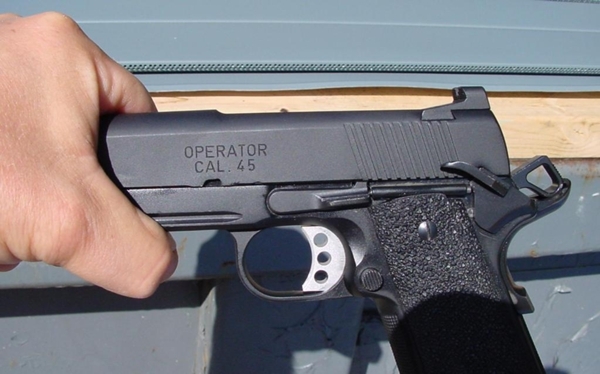
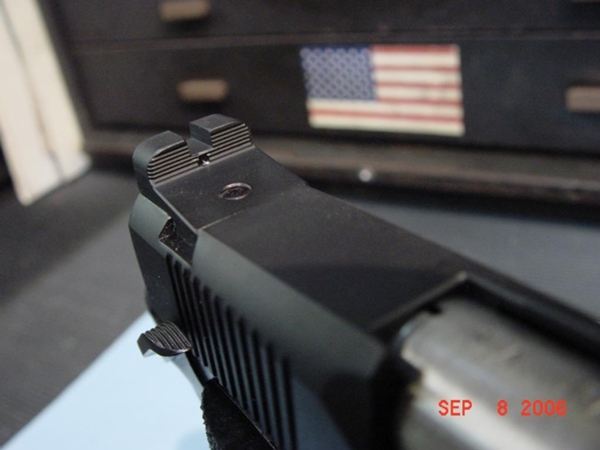
The slide is lowered on top, from the ejection port back to the front of the rear sight. The forward part of the rear sight is likewise lowered, to make for a higher, more abrupt front surface to catch on the shield's edge. In addition, I've serrated the front. The one pictured, and the one I'll be doing on Rod's Caspian, are YoBo sights that have been modified.
The resurgence of the rackable rear sight is coming from several quarters. I think Chuck Rogers was one of the earliest proponents, at least in this "cycle"........ I think the idea itself is as old as the idea of carrying a 1911 on horseback in place of a cavalry saber. One reason my Chicago-area guys are wanting them lately is that there's a new trainer in the area, Henk (that's how it's spelled) Iverson from South Africa. I won't get long winded about him but suffice it to say you don't do 23 years in SA as a cop and soldier without knowing a few things about fighting and surviving a fight (SA has a 25,000-man national police force and they lose about 1500 a year in line-of-duty deaths). I got to spend some time with him this summer and he is really passionate about training cops and soldiers in techniques that he has seen work.
http://www.striketactical.com
Here are a few pics of the Caspian:
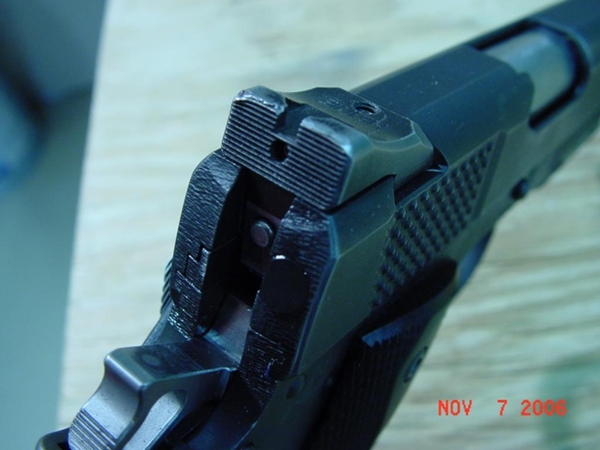
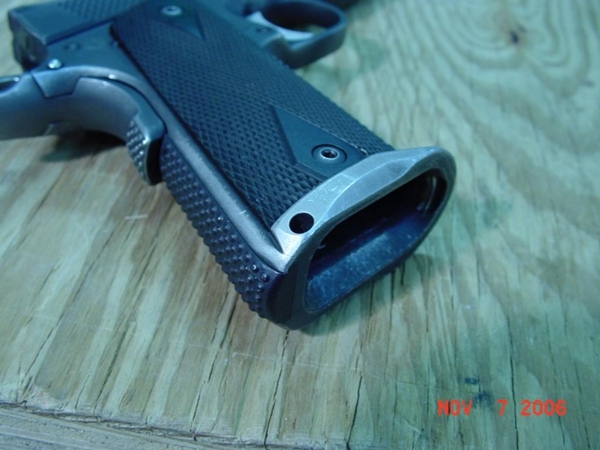
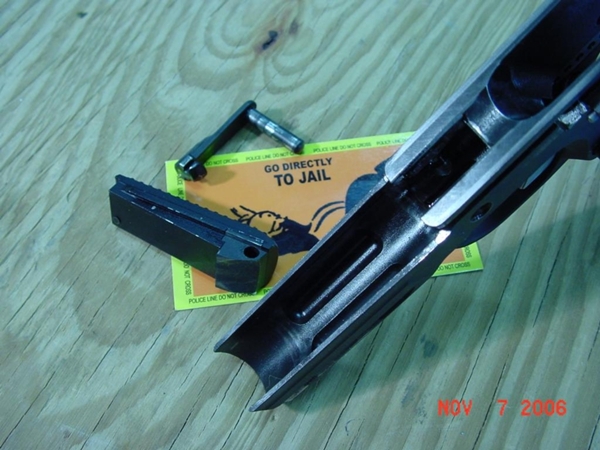
Sorry about the blue tint, gotta check those camera settings.
That's the back of Rod's card on the table.
The MSH is aluminum, made from scratch by me. Here again we can see that black anodizing really holds up well! This is a very special MSH, we wanted to use aluminum for the light weight to try and offset the weight of the rail on the dustcover (see also the lightening cuts inside the rail). But, I was afraid that Rod's shooting habit would quickly make a mess out of the magwell if the back part was aluminum, so I made a stainless insert to take the banging and scraping of fast reloads.
 Register
 Login
Login FAQ
FAQ


