Range Report Added 06-MAR-2010:
Flashing back to early childhood I recall the warmth and comfort brought by the rhythmic beat of windshield wipers on my daddy’s ’56 Chevy Bel Air drifting in and out of sleep in the backseat on long trips. But on this day the sound of wipers frantically slapping at the slushy mixture forming on the windshield of my Chevy 4x4 provided anything but warmth and comfort as I continued pressing North by Northeast through lightly falling rain and snow. Nervously glancing at the thermometer built into the rearview mirror of the truck, I mumbled aloud, “Damn, we dropped another two degrees.” Knowing full well where I was headed in Dawson County it’s typically four to five degrees colder than home.
Eight miles from final destination ambient temperatures were teetering on the freezing point and frozen precipitation was pelting the windshield of the big Silverado with more persistence than before. “Too late to turn back now,” I said quietly to myself, as if somehow that would bring relief from the mounting anxiety. The conversation with my wife just prior to departure began playing through my head again and again like a maddening continuous loop… driving me closer by the minute to the edge of pandemonium.
“Have you lost your mind?” She snipped. “Look outside… you can’t shoot in weather like this,” she said with authority pointing through the Keeping Room window. “What will you do if you get into an accident or if your truck gets stuck on the ice in the middle of nowhere?!!”
God, I hate when she’s right… and lately that’s been about ninety-eight percent of the time. Four-wheel drive is practically worthless in North Georgia ice storms and she knows that. But the burning anticipation for range-testing my new gun overruled common sense. This moment would likely be my last opportunity for several weeks to come.
The first attempt at reasoning with her must’ve sounded pretty lame, “I don’t get many opportunities to shoot these days with traveling for work and all… and the weather this winter has been brutal.” That didn’t faze her so I tried, “Besides… I need to practice shooting in bad weather.” Oops, that got her attention.
Pivoting her head quickly toward me wide-eyed at the mental picture of her husband standing up to his ass in ice and snow on a gun range firing a pistol, she cross-examined, “Practice shooting in bad weather?!! My God, why on earth would anyone in their right mind need...?”
“Well,” I stammered, fumbling to put the lid back on that can of worms, “Unless I’m the bad guy, I won’t get to choose the time, place or weather conditions for a gunfight.”
“Wow,” I thought to myself, “Did I really just say that? What a complete bonehead!”
Braced for impact, I was pleasantly surprised with my wife’s lack of reaction. “Well then, do what you have to do,” she said softening her tone, “But you are crazy.” Based on her latest batting statistics at close to ninety-eight percent, she was probably right again.
Upon arrival at the gun club, thankfully only a light mist was falling with no significant ice accumulation. Predictably, nor was there any sign of intelligent life. Wasting no time in the miserably cold, wet weather, I setup on the 15-yard steel plate range for function testing the magnificent Harrison-built Colt. Bringing one-hundred rounds of 230 grain FMJ Winchester factory .45 ACP ammunition and one-hundred-fifty rounds of my favorite home-grown stuff; 200 grain LSWC over 6.5 grains of Hodgdon Universal Clays; I was well prepared for evaluating the gun’s overall performance.
Initially focused on reliability and functional testing with little concern at that moment for hitting targets, I quickly stuffed eight rounds of Winchester factory ammunition into a Wilson Combat magazine and charged the pistol. Pulling it sharply from a Bulman QRH holster, I mowed down the steel plates in a rapid six-shot succession. As the last plate fell, I pivoted the muzzle onto a 5.5” Birchwood Casey Shoot-N-C placed 20 yards out and 8 feet right of the plate rack, locking the gun’s bright gold bead on target. “BA-BANG!” the big Colt barked once again, snapping-off its remaining payload with a double-tap locking cleanly open on empty. The first round of the closing two-shot string nailed the Shoot-N-C almost dead center. The second shot hit approximately 1.5” high and 1” right of center.
Securing the weapon, I could not contain my excitement. “Holy [smokes]!” I exclaimed aloud admiring the pistol with a frozen grin, “This [freaking] thing is unbelievable!”
After firing those eight exhilarating opening shots I remember thinking, “Geez… all I did was pull the gun from its holster and point it in the right general direction." The rest just seemed to happen magically all by itself, as if the Colt was possessed by a demon or something. "Nah, despite my wife’s opinion I’m not quite that crazy ____ yet,” I reasoned with myself. It’s just plain brilliant engineering, great craftsmanship and skillful calibration of a classic weapon by a world-class gunsmith.
A total of two-hundred fifty rounds were fired with the new Colt for its reliability and accuracy evaluation. From a reliability perspective, the gun successfully fired all one-hundred Winchester factory cartridges with zero malfunctions or hiccups of any kind, ejecting the empties cleanly and consistently about 5 or 6 feet to my right. Upon inspecting the fired brass, I could find no evidence of timing or collision issues whatsoever.
The trigger on this beast is without doubt the sweetest I’ve ever personally experienced. Breaking cleanly and consistently with zero creep and no discernible over-travel at an estimated 4 pounds, it just begs the operator to string multiple shots together.
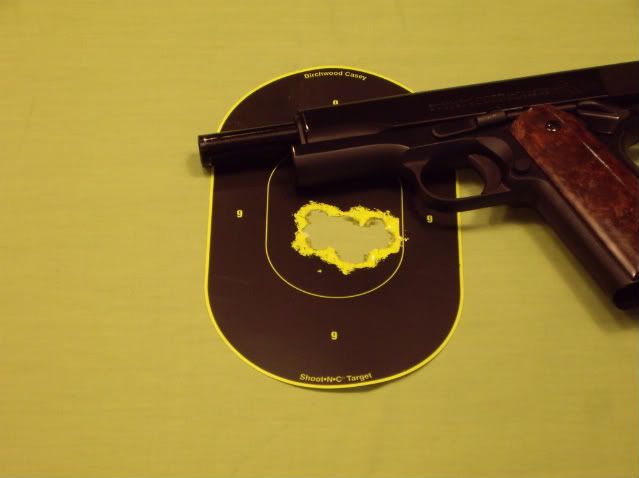
The gun’s accuracy with either the hand-loaded or factory ammunition was extraordinary. I do not own a bench-top pistol rest therefore all accuracy testing was conducted off-hand. The first photograph below illustrates the Colt’s best group for the day.
No, smarty-pants… I heard that remark. You won’t find any powder burns on that target. The eight-shot group was slowly fired off-hand from a measured distance of 20 yards, carefully aimed using a classic two-handed, thumbs-forward hold.
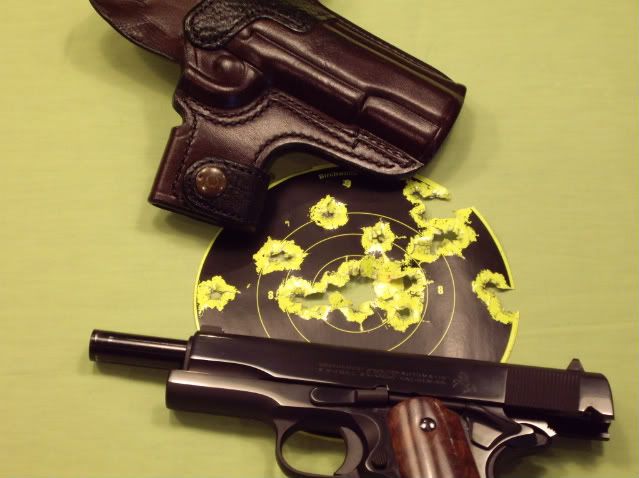
The target pictured below is fair representation of the gun’s average accuracy for the day at 20 yards conducting speed-shooting drills drawing from a holster. That was three payloads (twenty-four rounds) fired on the pictured target.
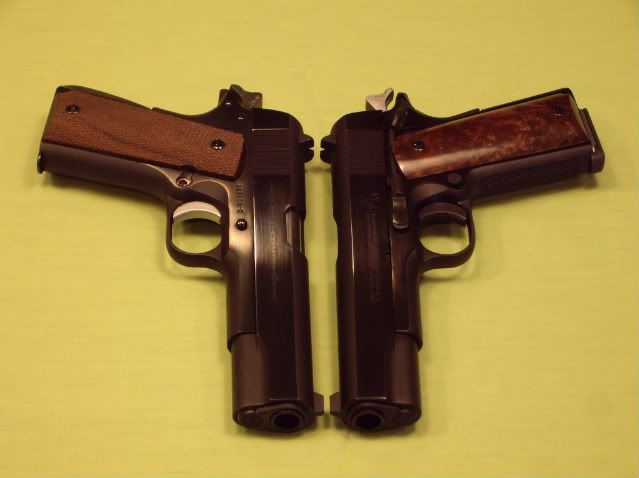
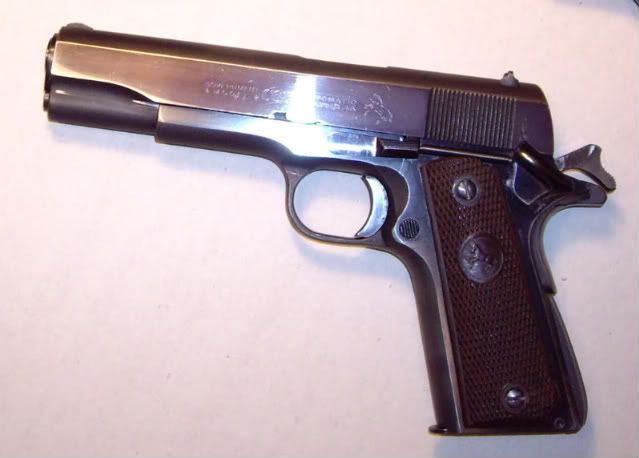
During the evaluation I occasionally swapped to an unmodified (with exception of sights, trigger & grips) ’53 Colt Commercial Government Model pictured below next to its new stable-mate. It was utilized for direct A-B comparison to the Harrison-built ’69 model. Although a damn nice gun as well, gripping the stock ‘53 Government Model felt almost like holding a 2x4 after mounting the ’69 model enhanced with John’s ergonomic refinements. The contrast is nothing short of amazing.
In closing, the return on investment in the specified enhancements can be measured by increased speed of presentation from a holster, more consistent shot placement and improved accuracy compared to its unmodified counterparts. However, in the final analysis the real product John delivers to his clients is greatly improved operator confidence, comfort and control of the weapon, plus the added bonus of handsome good looks.
We’ll watch carefully over the next year or so to see if the curse bestowed upon me by the evil Safe-Queen has finally been broken by this magical Colt. I certainly hope so… because carrying and shooting a fine classic weapon sure beats the hell out of kissing a frog. Just ask Mrs. DHRoss how that frog-kissing stuff worked out.
 Original Post:
The fabulous custom handguns John Harrison builds for me lead a sheltered life. Shooting them at the club occasionally on sunny Sunday afternoons brings a special thrill that would rival a teen’s first solo drive in his daddy’s T-Bird. But frankly I struggle with subjecting those polished, blue-steel beauties to the rigor of daily carry, heavy range use and the finish wear that accompanies regular handling and holstering. On occasion John harasses me for being so fastidious about his custom works uttering something to the effect, “C’mon, Dude, they’re made to shoot. If you [mess] something up, I’ll fix it.” But whether my behavior is perfectly rational or a latent manifestation of Obsessive Compulsive Disorder matters not in the final analysis. Those special guns will be babied like precious heirlooms rather than utilized as common tools while I remain of dubious mind and sound body. That we can take to the bank.
This particularity toward my gallery of John’s custom works eventually led to relegating duties for heavy range and frequent carry to alternate weaponry; primarily stock Colt Series 80’s and Glocks. There’s really nothing wrong with that scenario. In fact some experts would argue that packing a Glock is a more effective defense strategy anyway than betting your life on a firearm that was designed a century ago. But right or wrong, my alternate defense battery fell short of satisfying an itch. There always seemed to be an element missing from the formula… a nagging sense of discontentment that I eventually discovered could only be remedied by carrying and shooting with regularity a custom-made Colt 1911-style firearm. So when I surrendered my tired 1969 vintage Commercial Government Model .45 Automatic to John for complete rework the objective was crystal clear. Produce a working pistol based on the classic Colt five-inch platform, graced by the skillful hands of a world-class gunsmith. A weapon that would be carried, holstered and shot without reservation or self-imposed limits.
When my name eventually worked its way to the top of John’s waiting list during the holiday season, he called cheerfully to notify me. With great excitement I suggested we discuss the project at my home over cocktails, hors d'oeuvre and a few games of Eight-Ball (I usually let John win). After he’d mopped the table with me five out of six games, I presented him the subject pistol. John inspected it briefly and asked in a festive tone, “Okay, Santa… so what would you like me to do with this piece of [scrap metal]?"
I began, “You know, John, I just love packin’ a full-sized roscoe, and...”
John intercepted, “We should all be so blessed,
Fabio… but would you mind staying focused on firearms?”
Following clarification of my unfortunate idiomatic expression,

I explained to John the safe-queen dilemma and described in great detail my unyielding objective. John listened intently and afterward offered several solutions. But by then Crown Royal had begun influencing my thinking so foolishly I challenged some of John’s suggestions with a popular quote by Colonel Jeff Cooper, as if he hadn’t heard it a thousand times before.
"The only accessories that a 1911 needs are a trigger you can manage, sights that you can see, and a dehorning job.”
In his trademark gentleman-like demeanor John offered, “But if we can improve the gun’s accuracy and enhance its handling characteristics without compromising reliability, why would we not?”
Apart from the obvious financial side of the equation there was no logical argument… or at least one the Canadian spirits could produce for us at the moment. “Okay, John, you’re right,” said a familiar voice sounding much like mine, “It’ll be a tuned combat pistol with accuracy improvements and ergonomic enhancements … but no bells and whistles.” The adult beverage(s) and I jointly pursued further confirmation adding, “And for the sake of reliability under adverse conditions the gun will not be fitted too tightly, right?”
Realizing that his friend and client was no longer dealing cards from a full deck,

John taunted, “I’ll simply remove the rattle,
Callahan, so when you’re sneaking up on the bad guys they won’t hear you coming a hundred yards away. Would that suit you,
Inspector?” We shared a hearty laugh.
In the usual fashion that we’ve come to expect from John, his execution of the design specification was beyond brilliant. The most suitable description of the finished product that comes to mind is; an understated, minimalistic approach to hand-crafted weaponry that reflects elegance in a way that only a classic Colt firearm blessed by the hands of a genius could. Aside from obvious aesthetic appeal, its raw performance aspect would command the utmost respect from its most worthy adversary. In summary, this gun is one handsome, ass-kicking machine.
I love the gun, its builder and the deep satisfaction that carrying and shooting a finely-tuned classic weapon brings, free from concern for scratching or wearing thin its polished blue finish. Believe it or not, I’m looking forward to it showing honest wear and tear. Assuming, of course, the wear patterns are perfectly symmetrical and evenly distributed (C’mon… I’m joking).
John’s well-placed parting shot following final delivery of the product was, “Okay, so you’ve got your custom-built workhorse. Now wear that damn thing out, Brother… so I can restore it or build you another one.” And so I will give it my best effort.
Photo Documentary:
Notice the pragmatic approach to reconstructing this classic piece of hardware. No drama, no fanfare and no brass band; it's just a big ol’ satisfying hunk o’ Colt 45 Auto… Yeah, baby!
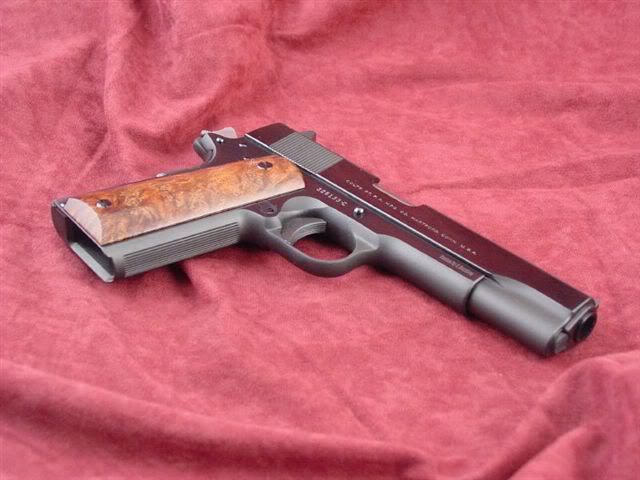
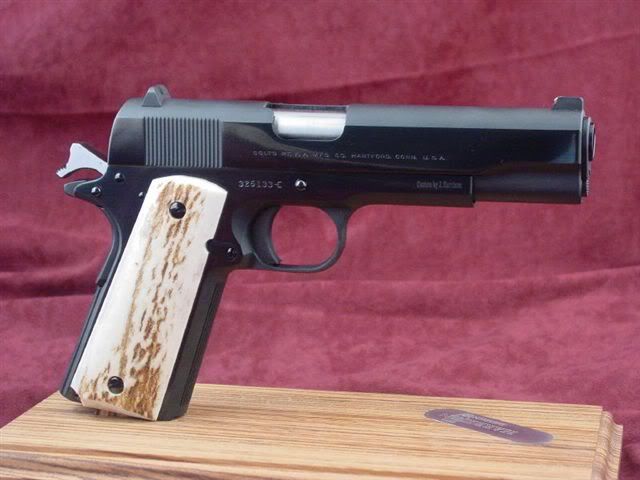
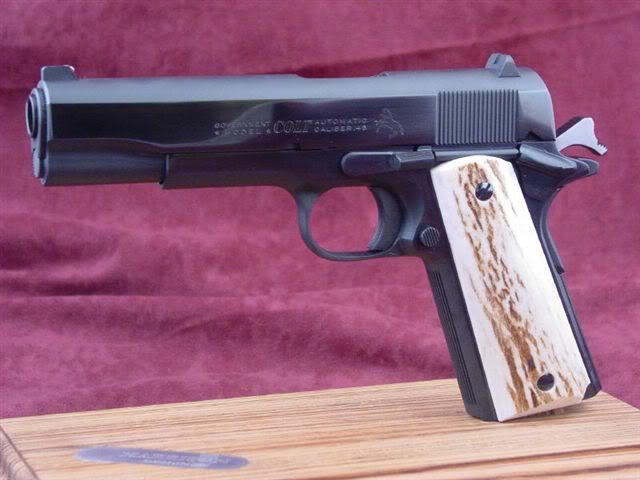
Okay… so it’s dressed in new Sambar Stag grip panels for the photo session which some may argue is a bit too flashy for a working gun. Mom taught us always wear our Sunday best when having our picture taken.
There, you see? Even a dreary old Black & Decker Wildcat enjoys dressing up once in a while. It brings relief from the daily “grind” (sorry, I just couldn’t pass that up).
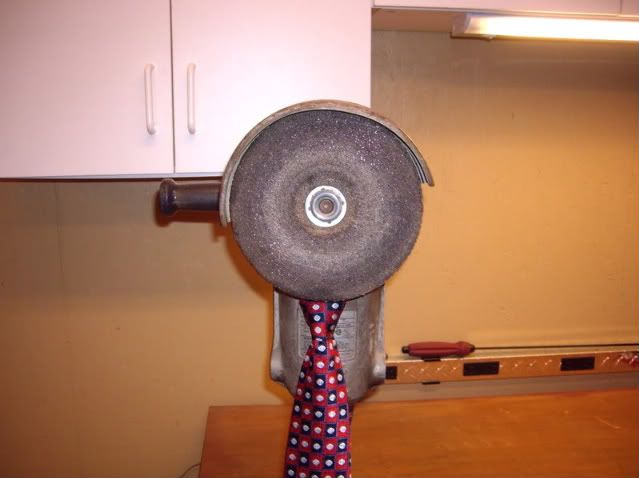
I know what you’re thinking. The previous photo of the grinder begs the question… should a man who photographs power tools wearing neckties be trusted with loaded firearms?

It’s okay… really. Just lock your tools away when I’m around.
Ahhhh…good old polished blue; it’s still my favorite finish especially for Colt firearms despite today’s modern high-tech, wear-resistant systems. Glenrock Blue does first-class work.
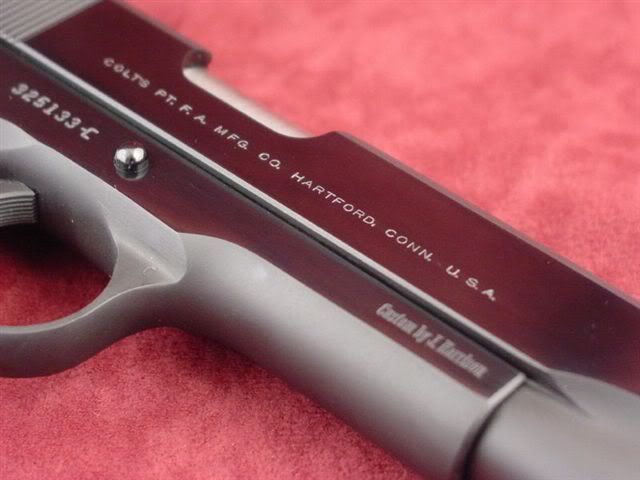
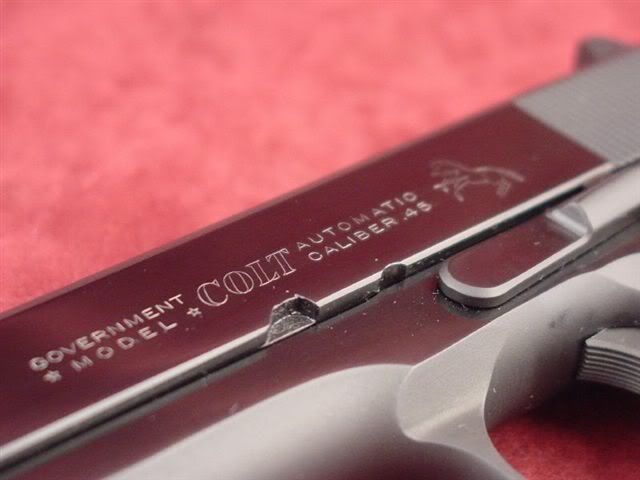
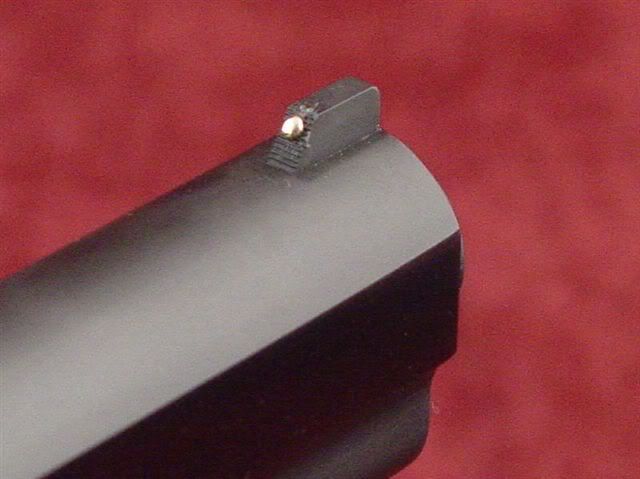
Take note of the muzzle treatment. Would-be assailants should enjoy the view of this fine weapon from their angle too. “Smile, please… and wait for the flash.”
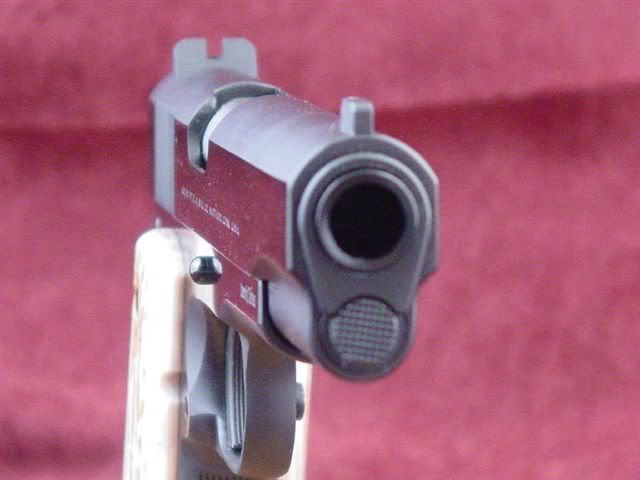
The Retro Rear Sight, now produced by Harrison Design & Consulting, teamed with an MGW staked-in front sight sporting a gold bead offers the operator crystal clear sight-picture and lightning-quick target acquisition. It’s a near-perfect sighting system for a no-nonsense Colt; simple, rugged and effective.
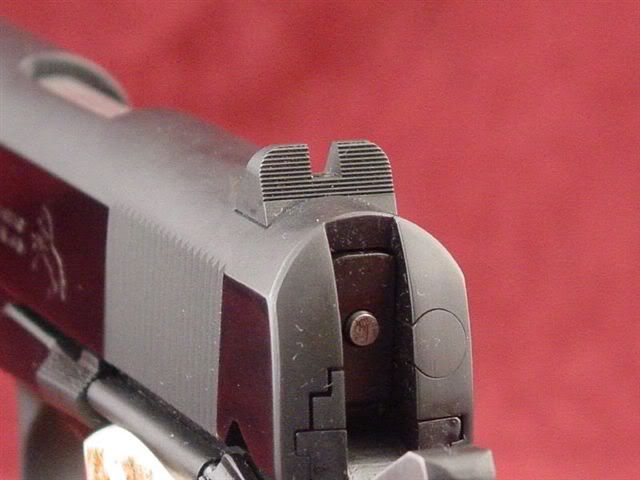
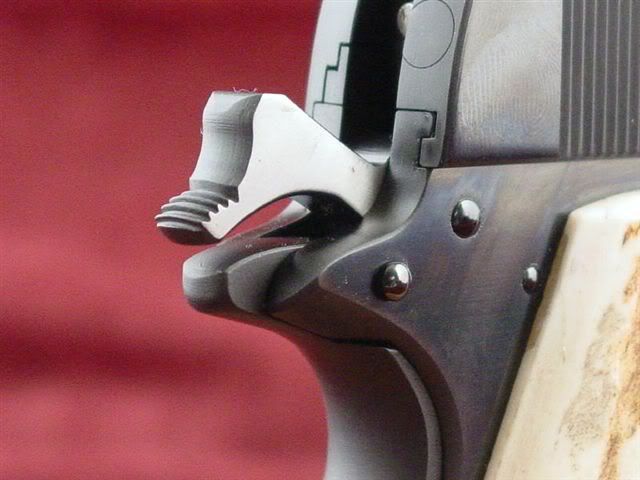
What? No slotted Commander hammer… no beaver-tail grip safety? What were you thinking, Dude?
I was thinking my medium-sized hands have never been mauled by a rabid spur hammer, so the factory hardware skillfully reworked by Mr. J.B. Harrison works just fine. Holding steady on the target objective, any modification offering no significant functional improvement has no place on this gun.
What the hell, man… that thing doesn’t even have an extended thumb safety. How can you call it a custom gun?
Every single part and major component of Mr. Working-Class Colt has been tweaked, modified, replaced or reworked by John’s masterful hands; right down to the springs, screws and pins. And it is ergonomically calibrated specifically to its owner/operator’s hands, size, shooting style, etc. How could that not be described as “tailor-made”?
With respect to thumb safeties, I’ve found that OEM-style units provide plenty of shelving space for supporting the both-thumbs-forward grip technique. So for a daily carry pistol, we reasoned against adding needless bulk and bling.
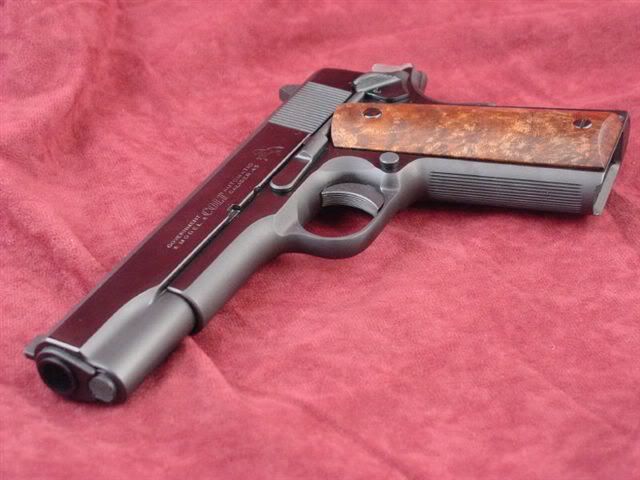
Also please note in the applicable photos that John’s expertise and creativity does not stop at metal work. Those walnut grip panels were handmade by Mr. Harrison. The photos do John’s fitting, sanding and oil work and the wood's natural light-refractive properties absolutely no justice. They are simply magnificent to behold!
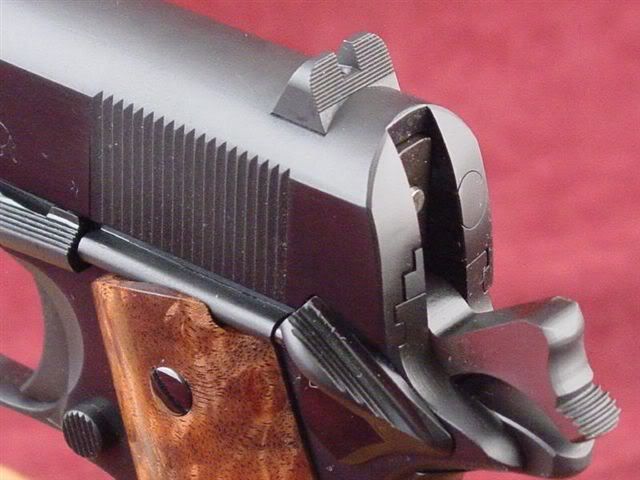
Some of John’s ergonomic refinements are so subtle they’re not visually apparent to the casual observer. He’s developed instinct for slightly reshaping the gun at its critical contact points with the hand. Removing minute amounts of material from the front strap and underside of the trigger guard facilitates a more secure purchase on the weapon offering the operator quick, fumble-free presentations from a holster and reliable opening-shot placement.
Further adjustment included material removal at the rear of the gun along the underside of the grip safety and frame tangs where it presses into the web of the shooter’s hand lowering its bore centerline. When properly executed these subtle enrichments reap extraordinary rewards in comfort and control of the weapon without noticeable alteration of its appearance.
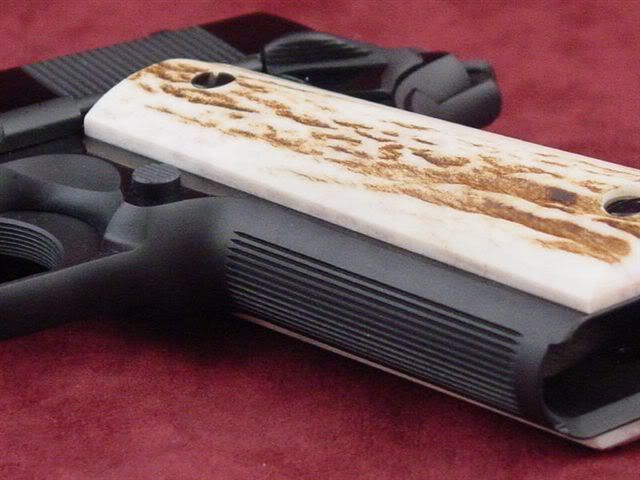
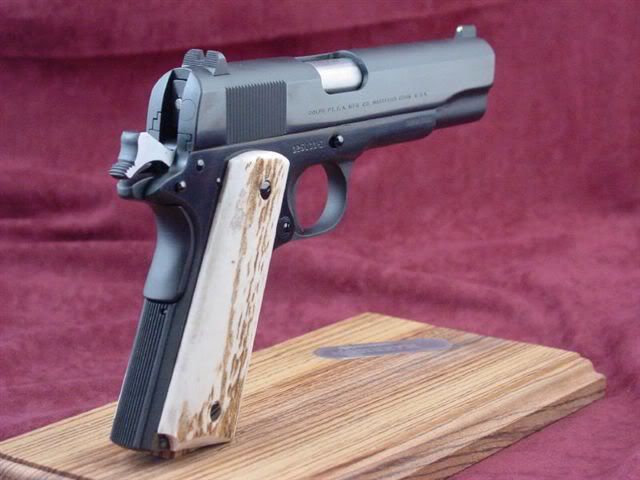
Note the trigger appears almost factory original, but is a precisely fitted HDC Extreme Service, blackened aluminum unit. Yes, it does have a travel-stop that is not visibly apparent. Its dowel is factory bonded to the backside of the trigger and carefully filed-to-fit for permanent adaptation to its host gun.
The benefits are there is no access hole in the trigger-face to snag the shooter’s index finger and no adjustable setscrew found on common aftermarket triggers. Purportedly setscrews can gradually work their way inward from vibration under fire, possibly disabling the weapon when it’s needed most.
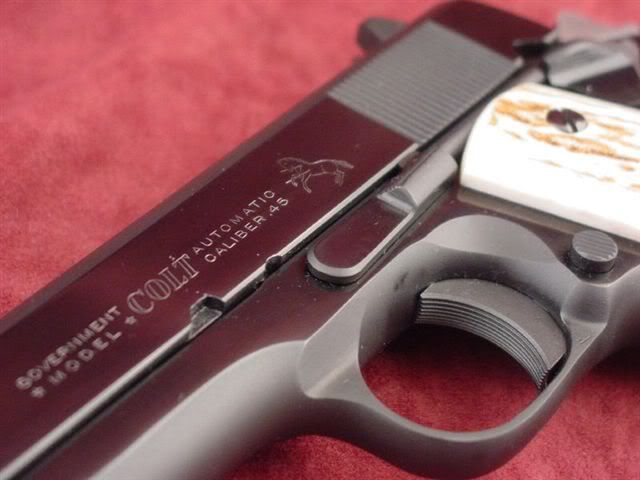
Note the expert machine-work applied to the factory magazine well opening. My personal armourer, trainer and mentor, Master John Harrison says… “When Vigoro meets Mixmaster, Grasshopper, quick-smooth magazine changes separate gunfight winners from losers.” And to my knowledge, John hasn’t lost a client yet... well, at least the ones that pay on time.
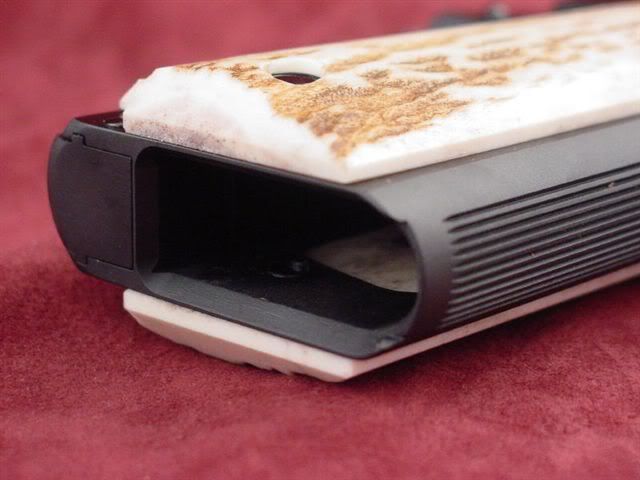
The range test and subsequent report planned for this beauty will follow once weather conditions for Northwest Georgia improve. Recent statistics published by the National Weather Service indicate North America’s coldest, snowiest winter since the late 1920’s. I wish Al Gore and his Kool-Aid drinking buddies

would send a little of that Global Warming our way soon. Stay tuned.
 Register
 Login
Login FAQ
FAQ


 They are all great.