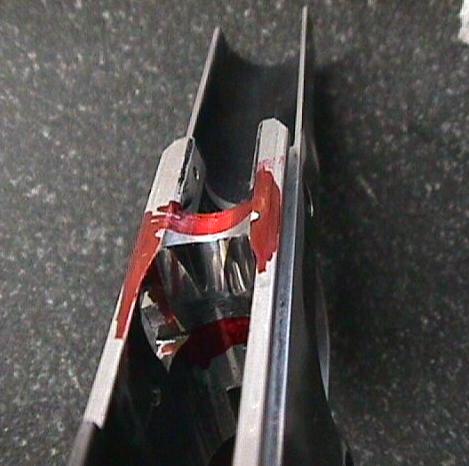
This is something new I've been developing for a couple years now. I say "new".... well, I guess what that really means is I have not seen it done before.
Frame to slide fit on aluminum-framed guns (that somehow often seem looser that other guns, in general.) I absolutely love the feel of one that has had Accu-Rails installed. That was one of the best ideas to come along in a long time and we are fortunate that someone is still doing it-- I hope that continues. A few downsides maybe, even if we say cost is no object. You have the rails to deal with when the gun is apart. I don't recall ever breaking one or seeing one broken. I am somehow convinced it has happened, like I've seen it, but I don't have an actual mental picture I can bring up. I've heard they have been known to break when dropped, but I have dropped them and not had them break. That might have been internet conjecture.
I am amazed at what can be done with laser welding, the puddle area of the weld is so miniscule that usually, or maybe always, the parts don't even get too hot to touch. Depends on a lot of things of course, but now having experienced a lot of frames that were laser welded up with no stress or heat-induced warping, I thought, why not some weld on the slide? On the aluminum frame, as good as laser welding is, as I understand it, it cannot produce a fresh surface that is not on the soft side and gummy.
That is not to say TIG is outdated for weld and refit jobs, it's absolutely fine, but I don't know that I would do it on a slide.
My new ("new") method is to weld up the bottom of the slide rails and the bottom verticals, and recut; fit to existing frame rails. On these two the buildup had to be between .005 and .008. I've seen sloppier and less sloppy ones. We are still running a piece of steel on aluminum-- also true with Accu-Rails-- but I get the new surfaces very, very smooth, almost glossy; wear on the aluminum rails will be minimal. In this method the new surfaces are broad, and square with a lot of smooth-on smooth contact. I mean the very worst wear would be back to where it was in the first place but I don't think the rest of the gun will last that long! Most often an improved fit is via widening the top rail only; here we are getting the fit at the nominal .625 frame rail slot. I've done every surface before, lots more work of course, not a ton of actual reward.
The first time I ever did this was on an all steel gun, just to get more bearing area. "White horse" was the gun, it's on LTW somewhere.... that was with TIG but in 45° strips along that bottom vertical in the slide, to avoid any distortion.
Not saying this method represents a cost savings-- the welding alone would have bought me an Accu-Rail job and we'd have all been happy. Just an experiment, and incremental improvement I think. This way when you're working on your friend's Commander in the back of a Jeep with holes in the floor while your friend is in a Caracas liquor store getting "supplies" (actual story, me doing the repairs), you can still lose other parts perhaps but at least no Accu-Rails will be fumbled and dropped onto the street below (citing again my record of dropping Accu-Rails

).
I don't believe that in either of these guns, accuracy will be improved enough to notice. It for sure won't hurt it-- but both shoot quite well already. I believe a better fit actually improves reliability though, and more bearing area improves longevity, and, of course, at a certain price point, a custom 1911 customer would "rather not" have it all rattly.... it has just come to be expected.
I've had several of my signature 1911 features appropriated, copied, and blatantly knocked off, as have many other smiths who have developed their own style. I haven't liked it, it has disappointed me. BUT.... somehow, for some reason, I feel differently about this. I will utter no complaint of someone else wants to take a whack at it. A mention is always appreciated, of course. It works quite well. More pics to come.

 Register
 Login
Login FAQ
FAQ


 I can say that because I am aflicted with that particular disease.